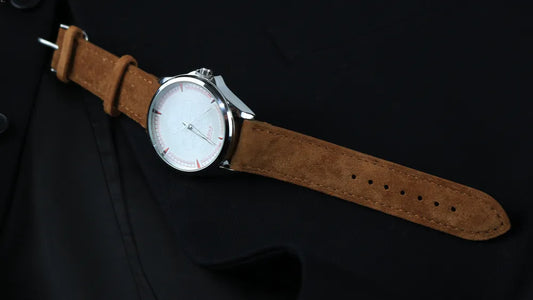
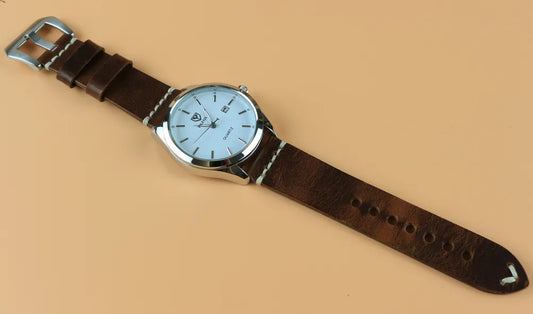
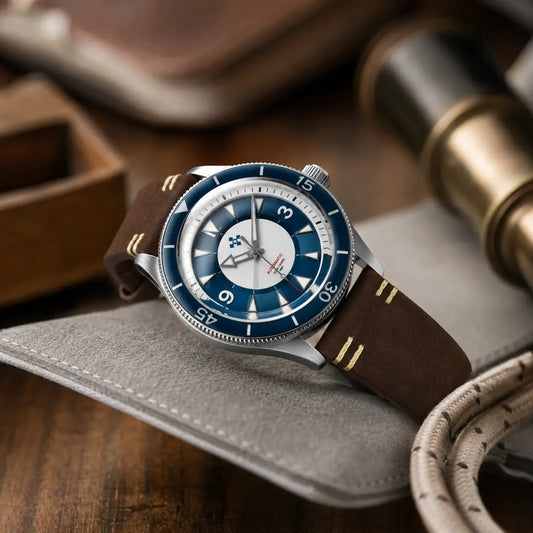
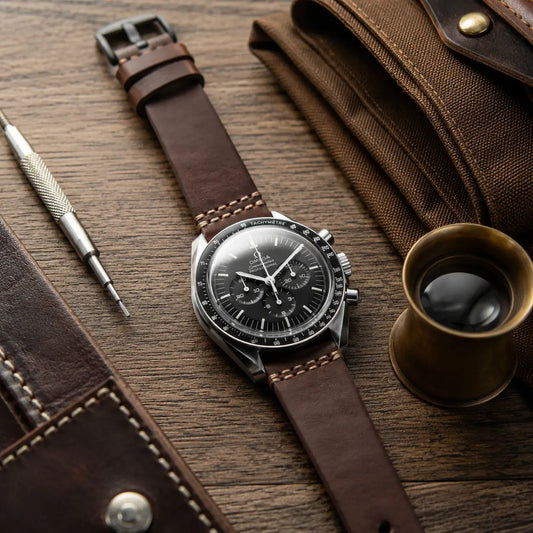
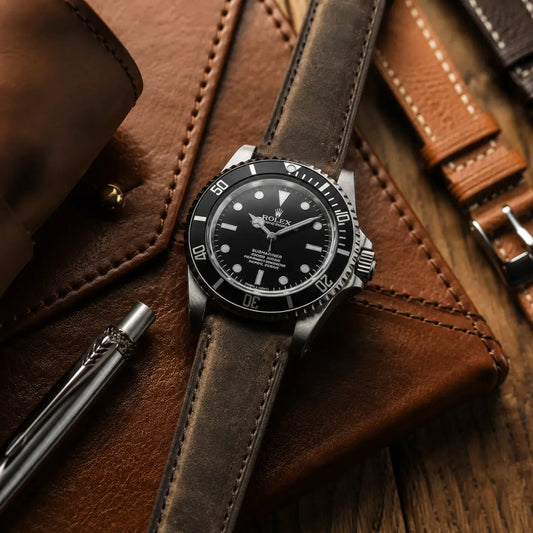
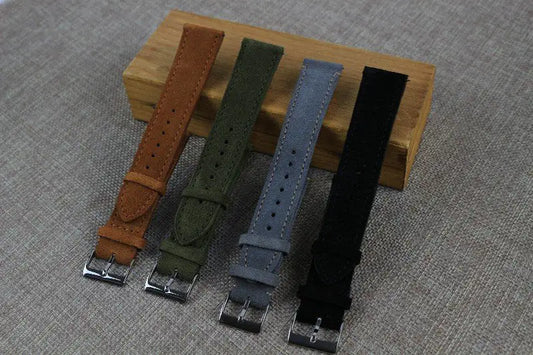
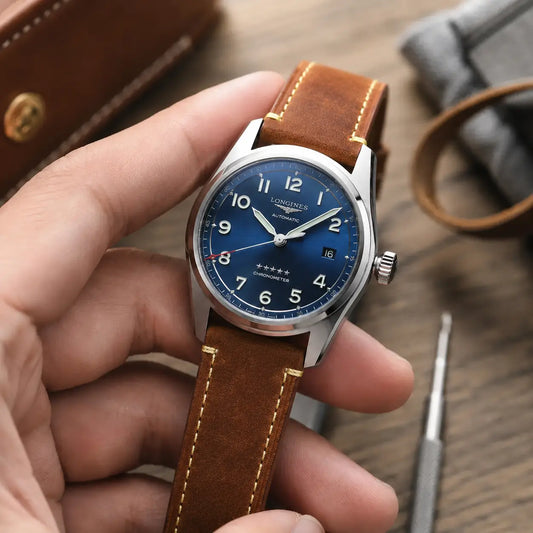
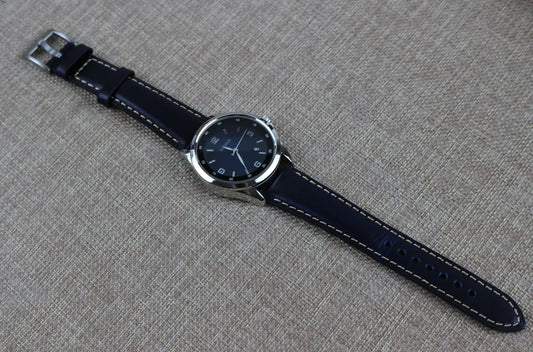
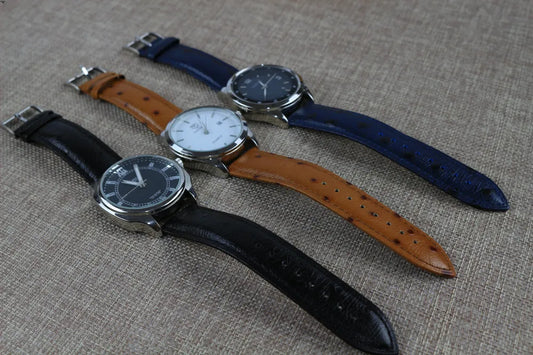
The oils from your skin, the light creases from daily movement, the slight darkening at the edges — these are not signs of wear. They are signs of a strap that is alive and maturing. A well-kept full-grain leather strap after two years of wear is more beautiful than the day it arrived.
This is why serious collectors own leather straps. Not just because they look refined — but because they improve as an investment in a way no synthetic material can replicate. TASCONY leather is sourced from the same calibre of tanneries that supply European luxury houses — that provenance matters, and it is visible in the finished product.
Full-grain leather is the only strap material that genuinely improves with age. Every other material degrades from day one. Leather gets better.
Understanding Leather Grades — Why It Matters Before You Buy
Not all leather is equal, and the difference between grades is not subtle over time. TASCONY stocks only full-grain and top-grain — the two premium tiers. The third tier, 'genuine leather', is what mass-market replacement straps are made from. We do not stock it.
Full-Grain
- Outermost hide layer — untouched, natural grain intact
- Strongest and most breathable grade
- Develops the richest patina over time
- Best for: Daily wear, dress watches, long-term investment pieces
Top-Grain
- Sanded and finished for uniform appearance
- Slightly less breathable than full-grain
- More scratch-resistant on the surface — still premium
- Best for: Formal occasions, polished case watches, gift purchases
Genuine Leather (not stocked by TASCONY— listed for
comparison only)
- Third grade — taken from lower hide layers
- Heavily processed, loses natural grain character
- Does not develop patina
- Fails sooner — typically at stitching or lug holes within 12–18 months of daily wear
A strap described only as 'genuine leather' is the third grade — heavily processed, does not develop patina, and typically fails at the stitching or lug hole within 12–18 months of daily wear. TASCONY stocks full-grain and top-grain exclusively.
For a deeper exploration of leather types, grades, tanning processes and stitching quality, read our Ultimate Guide to Leather Watch Straps.
Choosing Your Texture — Crocodile, Epsom or Pebble
TASCONY leather straps are available in three surface textures, each applied to full-grain or top-grain hides through a different finishing process. The texture changes the entire character of the strap — choosing the right one is as important as choosing the right colour.
Crocodile
- Raised tile pattern, available in high-gloss or matte finish
- Formal and distinctive without being loud
- Pairs best with: Dress watches, gold-tone hardware, black or navy dials
Epsom
- Fine, tight grain with a slight sheen
- Holds its shape exceptionally well
- More resistant to surface scratches than smooth leather
- Pairs best with: Smart casual wear, stainless steel or rose gold cases, daily wear
Pebble
- Soft, rounded grain — relaxed and unfussy in character
- The most forgiving texture for everyday use
- Pairs best with: Field watches, bronze cases, vintage dials, weekend wear
If you prefer warm brown tones across any of these textures, browse the brown watch straps collection for the full warm-tone range. If unsure which texture suits your specific watch, contact us with the model and we will recommend the right combination.
The TASCONY Construction Standard — What Hand-Finished Actually Means
Most replacement watch straps are cut, stamped, and glued by machine. A TASCONY leather strap takes longer — because the details that determine how a strap ages, fits, and feels are the details that machines skip.
The Tapered Silhouette
Most TASCONY leather straps taper by 2mm — a 20mm lug end narrows to an 18mm buckle end. A tapered strap follows the curve of the wrist, distributes pressure more evenly, and ensures the strap end never bunches under the cuff of a dress shirt. Mass-produced straps are cut at a uniform width from end to end. The taper is the detail that tells an experienced eye whether a strap is premium or not.
Proprietary heat-painted edge sealing
Every strap edge is treated with heat to close the leather fibres, then hand-painted with a matching pigment finish — a process that prevents fraying, moisture ingress, and the progressive peeling seen in machine-glued straps. The result is an edge that looks finished from day one and stays that way for years.
316L Stainless Steel Hardware
Every buckle, keeper, and spring bar tube is 316L stainless steel — the same grade used in surgical instruments. It will not corrode, tarnish, or deform with daily wear, sweat, or humidity. Finished in brushed or polished tones to match your watch case.
A hand-finished leather strap is the single most effective way to restore the original factory-fresh look of a luxury timepiece — while adding a layer of personal character that the factory strap never had.
Personalised Leather Watch Straps — Engraving That Makes It Yours
Every TASCONY leather strap can be personalised with engraving — initials, a date, a name, a short message.
No other hand-finished watch strap brand in Australia offers this at this quality level. It transforms an already premium accessory into something that cannot be replicated or replaced.
The Most Considered Gift for A Watch Enthusiast
A personalised leather strap shows you know what someone wears, what they value, and that you took the time to make it specific to them. It works for every occasion where you want the gift to be remembered:
- Anniversary — a date engraved on the buckle end, visible only to them
- Birthday — their initials, subtle and personal
- Father's Day — a name or short message from the family
- Groomsmen — a matching set, each engraved with the recipient's initials
- Graduation — initials and the year, a strap that marks the moment
- Christmas — for the collector who already owns everything
Select your strap, add engraving details at checkout, and we handle the rest — dispatched the next business day.
Ordering for a gift? Contact us if you need gift wrapping or have a specific message length. We accommodate custom requests.
A Real Decision — The Omega Speedmaster And the Leather Question
You own an Omega Speedmaster Professional on its original bracelet. It is an exceptional watch. But at a colleague's dinner, the bracelet clinks against the table, catches the sleeve of your jacket, and sits slightly too formal for what is supposed to be a relaxed evening. You switch to a top-grain epsom leather strap in dark brown,20mm. Epsom's tight grain holds up to wrist contact, dark brown reads warm against the Speedmaster's silver case, and the slim two-piece profile disappears under a shirt cuff rather than competing with it. The watch becomes more personal, more approachable, and — with engraving — uniquely yours. For the full range of two-piece leather formats, see the two-piece watch straps collection. If you want that same leather aesthetic with the extra security of a single-pass design, the leather single-pass straps offer both in one strap.
Matching Your Leather Strap to The Occasion
Formal And Business Wear
Black or dark brown full-grain leather in crocodile or smooth texture. The colour should match your shoe leather — this is the most reliable rule in watch strap styling and it applies regardless of the occasion. Stainless steel or gold-tone buckle to match the watch case.
Smart Casual And Weekend
Tan, cognac, or mid-brown in pebble or epsom texture. These tones have the widest outfit compatibility — they work equally well with navy, olive, grey, and earth tones. The texture adds visual interest without adding formality.
Vintage And Heritage Watches
Vintage-dialled watches with creamy lumes, faded indices, or aged bezels deserve a strap that matches their character. Distressed leathers in tan and havana develop patina in sympathy with the dial — allowing strap and watch to age together. A full grain strap on a vintage piece should be left to develop naturally rather than conditioned into uniformity.
When Conditions Demand More Than Leather
While leather offers a refined aesthetic, it is just one part of our premium watch straps range, which includes high-performance rubber and rugged canvas options for every environment
For swimming, exercise, diving, or Australia's more humid summer days, a rubber watch strap is the practical choice — fully waterproof and maintenance-free. For casual weekend wear that sits between leather and rubber, canvas and fabric straps are breathable, lightweight, and available in a wide range of colours. Most serious wearers rotate across all three materials.
How To Make Your Leather Strap Last Five Years, Not One
- The routine is straightforward: condition every four to six weeks, keep it dry, and rotate between at least two straps.
The most common cause of premature leather failure is not wear— it is dryness from sweat and heat without conditioning. Australia's summer accelerates this significantly.
- If the strap gets wet, wipe immediately with a dry cloth and air dry naturally — never use a hair dryer or leave it in a hot car.
- Apply leather conditioner with a soft cloth every 4–6 weeks in summer, every 6–8 weeks in cooler months.
- Rotate between at least two straps — this allows the leather fibres to recover their shape between wears.
- Store flat or on a strap roll, away from direct sunlight. Never fold or crease the leather.
- Keep away from perfume, sunscreen, and hand cream — these degrade the surface finish over time.
For a complete cleaning, conditioning, and storage routine — including what products to use and what to avoid — read our Leather Watch Straps Care Guide.
Finding The Right Size for Your Watch
Measure the gap between your watch lugs with a ruler — this is your lug width and the strap width you need. The most common sizes are 20mm (Omega Speedmaster, Rolex Submariner, Seiko SKX, Hamilton Khaki, Tissot PRX) and 22mm (Tudor Black Bay, Seiko Prospex, larger chronographs). For a full walkthrough, see our Watch Strap Sizing Guide